
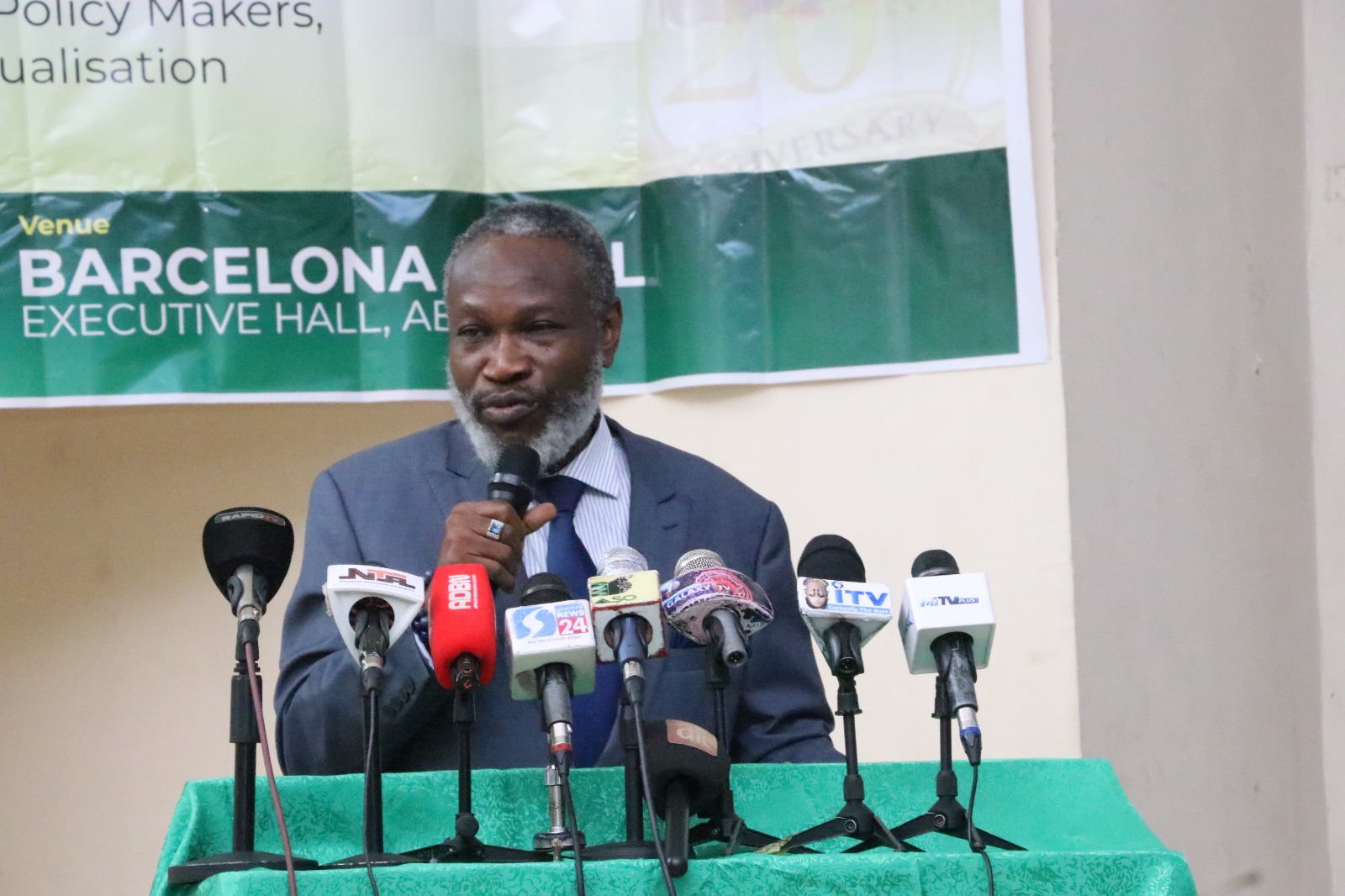
The First Deputy President of Abuja Chamber of Commerce and Industry(ACCI), Professor Adesoji Adesugba has observed that for Nigeria to achieve the $1trillion economy target by the year 2030, there must be an average annual expansion of about 28% in dollar terms by the Federal Government.
According to him, for sustainable economic expansion, Nigeria as a country need stronger industrial growth, reliable electricity supply and increased foreign direct investment.
Professor Adesugba disclosed this on Tuesday in Abuja while delivering his keynote address at the 20th anniversary lecture of the Commerce and Industry Correspondents Association of Nigeria (CICAN), with the theme, “Actualising the Federal Government’s $1 Trillion Economy: The Roles of Policymakers, Stakeholders and the Media.”
He said the $1trillion target should be seen and treated as a national
mobilisation rather than a guaranteed economic outcome.
He said its actualisation also depend on the quality of policy implementation.
He explained that in the second quarter of this year 2026, Nigeria's economy recorded 4.43 per cent of real gross domestic product growth and the first-half growth stood at 4.16 per cent, compared with 3.68 per cent in the same period of last year in 2025.
The First Deputy President of the ACCI and a former Managing Director of the Nigeria Export Processing Zone Authority (NEPZA) also noted that in the month of September this year there was decline in headline inflation of 14.63 per cent to 20.98 per cent of early this year, alongside an increase of external reserves to $55.25bn which he said the highest level in 18 years.
He, however noted that the capital importation reached $10.37bn in the first quarter of 2026, while the foreign direct investment accounted for$135.08m, representing 1.3 per cent of the total.
Professor Adesoji while acknowledging the improvements in economic stability, he also accepted the fact that Nigeria is yet to achieve the scale of structural transformation required to meet the target.
“Stabilisation has been substantially achieved. Transformation has not yet begun at the scale the target requires,” he said.
He also believed that all the stakeholders must come and work together towards the target including federal and state governments, policy makers, the media, private sectors and among others.
He also proposed that CICAN should establish a quarterly $1 Trillion Tracker to monitor key indicators, including real GDP growth, the dollar value of the economy, foreign direct investment, electricity supply, inflation, manufacturing output, employment and poverty.
He said "Whether we reach a trillion dollars in 2030, or a few years after, matters less than whether we build an economy capable of reaching it and sustaining it. That will depend on policymakers who stay the course, stakeholders who invest and produce, and a media that informs, verifies and holds all of us to account. Nigeria will not report its way to a trillion dollars. But it cannot get there without being reported honestly.
“I invite CICAN to consider establishing a quarterly CICAN $1 Trillion Tracker, an independent, transparent scorecard of the indicators that matter,” Congratulating the Association on the twenty years service to the progress and economic development of our nation.
Earlier his remarks, the CICAN Chairman, Comrade Gabriel Kuma, Said the 20th Anniversary Conference of the Commerce and Industry Correspondents Association of Nigeria, CICAN was more than a celebration of twenty years, rather it was a celebration of courage, perseverance, professional commitment and the enduring power of journalism to shape national conversations, influence policy and contribute to economic development.
"To our Honourable Ministers, Your Excellencies, our distinguished heads of agencies, industry leaders and all our special guests, we are deeply honoured by your presence. Your decision to set aside your demanding schedules to celebrate this milestone with us sends a powerful message: that the work of the media in advancing commerce, industry, investment and national development matters. association’s 20th anniversary was an opportunity to reflect on two decades of professional commitment to reporting commerce, industry, investment and economic development". He said.
According to him, the association which was formed and registered in June 2006, had grown from a modest professional platform into an organisation seeking to deepen public understanding of economic policies and their implications for Nigerians.
He said "twenty years ago, in June 2006, CICAN was registered. At the time, it was a modest beginning, the birth of an association with a vision larger than its immediate resources and ambitions that would require time, sacrifice and collective determination to realise.
Our beginning was much like that of a newborn baby. A baby arrives in the world full of promise but utterly dependent on others for protection, nourishment and guidance. It cannot walk, cannot speak for itself in a language the world understands, and cannot independently navigate the dangers that lie ahead. Yet, within that fragile beginning is the potential for growth, maturity and greatness.
That was CICAN in its infancy.
He said"we began with a vision, a professional calling and a determination to create a platform through which journalists covering commerce, industry, investment and related economic activities could work together, deepen their knowledge and make their voices count. But, as every parent knows, the journey from infancy to adulthood is neither automatic nor easy.
"There were storms to weather, obstacles to overcome, limitations to confront and expectations to meet. There were moments when resources were scarce, when the environment was less than encouraging, and when the demands of professional responsibility appeared greater than the opportunities available to meet them.
"Yet, like a child learning to stand, stumble, rise and walk, CICAN continued to grow. We learnt to navigate the difficult terrain of journalism, to engage institutions, to understand the complexities of economic policy and to appreciate that reporting commerce and industry requires much more than recording figures, announcing policy decisions or reproducing official statements." Observing that reporting the activities of Commerce and Industry demands understanding the connections between policies and people, between investments and jobs, between industrial production and national prosperity, and among other things.
The CICAN Chairman while calling on government agencies, businesses and development partners to strengthen their engagement with the Association and other media houses and support professional economic reporting, he also assured that the association remained committed in carrying out its duties to the national development.
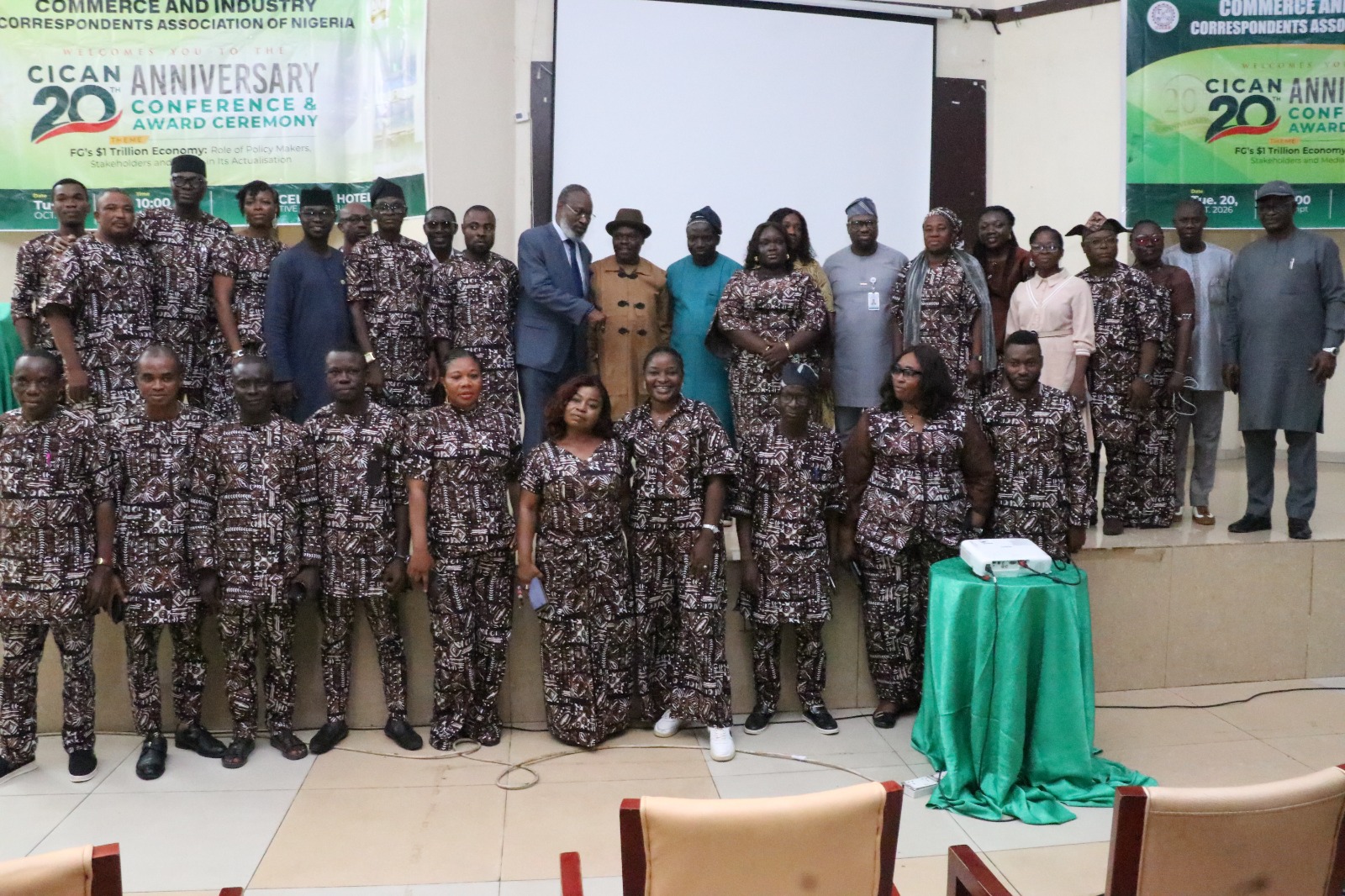
The CICAN 20th years anniversary attracted government officials, private sectors, civil society Organisations, the media with goodwill messages from various of government agencies including the Federal Competition and Consumer Protection Commission, the Nigerian Export Promotion Council and the Small and Medium Enterprises Development Agency of Nigeria, among other stakeholders.
The event also witnessed presentation of special awards to Professor
Adesugba and some heads of agencies under the Federal Ministry of Industry, Trade and Investment.
Comments