
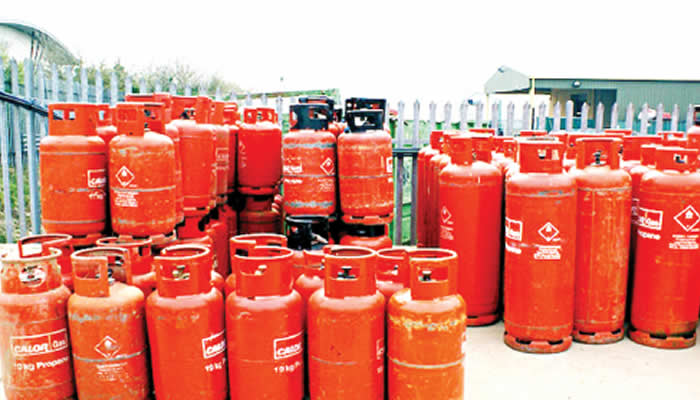
The price of Liquefied Petroleum Gas (LPG), commonly known as cooking gas, has continued to rise across Nigeria despite increased domestic production and a significant decline in imports, according to industry data.
Findings from the Nigerian Midstream and Downstream Petroleum Regulatory Authority (NMDPRA) show that local production from refineries and gas processing plants now accounts for the bulk of Nigeria’s LPG supply. This shift has reduced the country’s reliance on imported gas over the past year.
Between April 2025 and April 2026, domestic LPG supply ranged between 3,300 and 4,500 tonnes per day, with March and April 2026 recording about 4,500 tonnes daily. However, this increase in local production has not translated into lower retail prices.
Across many parts of the country, the price of cooking gas has risen sharply, reaching as high as N2,000 per kilogramme in some locations. This is a significant increase compared to previous months when it sold for less than N1,000 per kilogramme in several areas.
Data further revealed that imported LPG has dropped significantly. Imports declined from about 1,600 tonnes per day in November 2025 to just 200 tonnes per day in March 2026. Despite this reduction in imports and stronger domestic supply, consumers continue to face rising costs.
Marketers and stakeholders attribute the situation to persistent supply chain bottlenecks, distribution inefficiencies, and localized scarcity, which continue to disrupt product availability in different regions.
Many gas dealers report difficulty sourcing LPG consistently, leading to uneven distribution and price inflation in retail markets.
The rising cost of cooking gas is already having a visible impact on households, with many Nigerians switching to cheaper alternatives such as charcoal and firewood. This shift has raised concerns about environmental sustainability and the country’s clean energy transition agenda.
Industry data also indicates that several major gas infrastructure projects are nearing completion, which could improve supply in the near future.
The Ajaokuta–Kaduna–Kano (AKK) Gas Pipeline Project is reportedly 93.40 per cent complete, while the OB3 River Niger Crossing stands at 93.88 per cent completion. The ELPS Midline Compressor Project has reached 94.45 per cent completion.
Although these projects are expected to improve gas transportation capacity, stakeholders warn that infrastructure alone may not resolve the current pricing crisis unless distribution inefficiencies are addressed.
The Nigerian Association of Liquefied Petroleum Gas Marketers (NALPGAM) has also raised concerns over the situation, warning that rising costs could worsen economic hardship for millions of Nigerians.
According to the association, marketers now pay between N25.2 million and N26.2 million for 20 metric tonnes of LPG, a situation they described as unsustainable.
NALPGAM warned that if the situation persists, it could trigger wider market instability and deepen hardship among households, small businesses, and food vendors who rely heavily on LPG for daily operations.
The association urged urgent intervention to stabilize supply and pricing across the country, noting that the crisis threatens progress made in promoting clean cooking energy in Nigeria.
Comments