
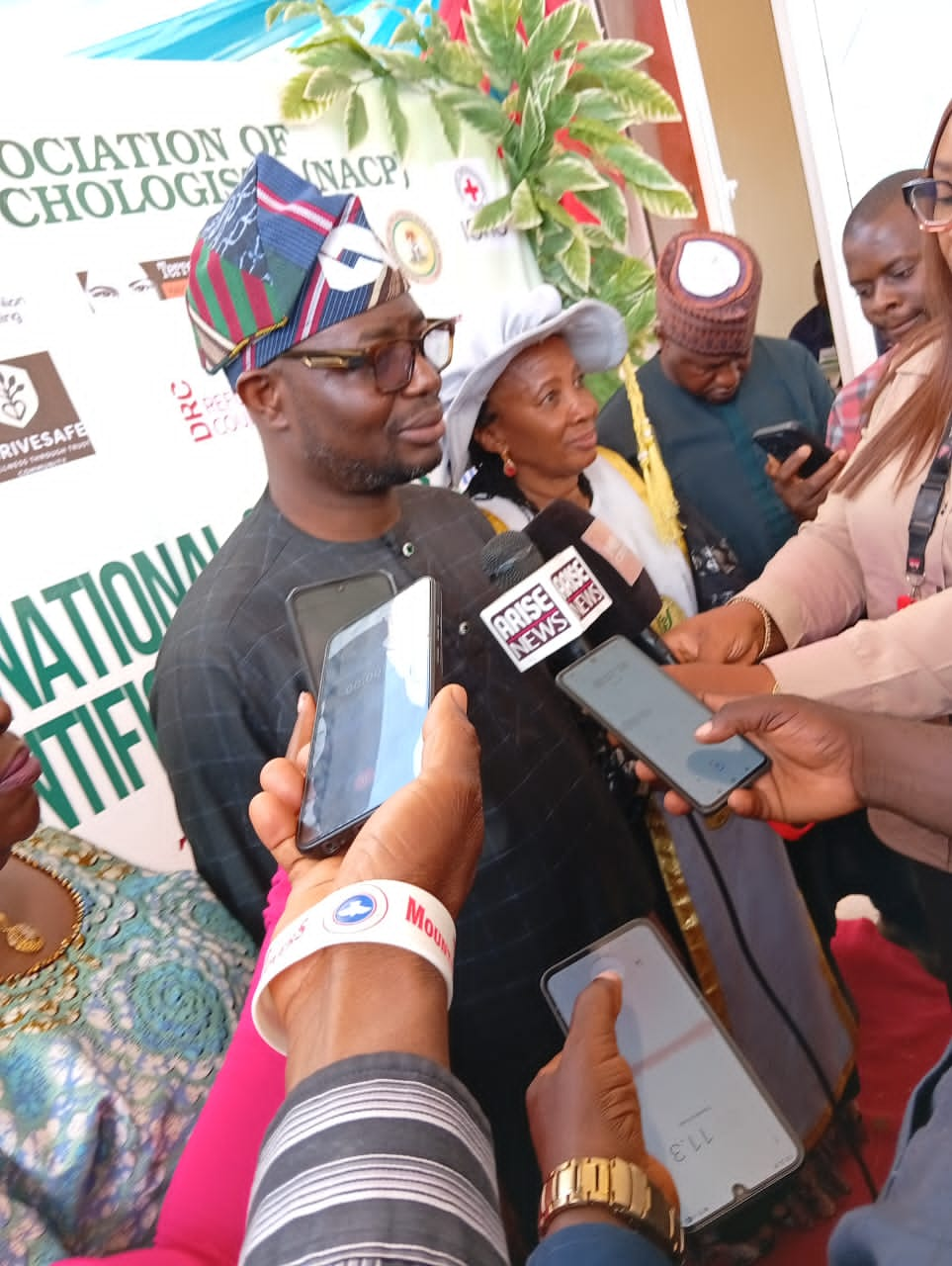
The Minister for Humanitarian Affairs and Poverty Reduction Dr.Bernard M.Doro has emphasizes that clinical psychologists, academics, researchers and humanitarian partners that Nigeria's humanitarian crisis does not end when violence stops.
"A crisis does not end when the shooting stops. It moves inside people. It sits in the child who no longer sleeps, in the mother who cannot return to her farm, in the young man whose anger has nowhere to go," he said.
Speaking in Jos on Monday while declaring open of a 5days Annual National Congress and Scientific Conference of Nigerian Association of Clinical Psychologist (NACP)said the theme of the Congress,"Bridging Research and Practice" is timely, noting that Nigeria does not lack evidence on trauma but lacks the bridge between research and real-world response.
While making referencing at the University of Maiduguri in September on the psychosocial impact of conflict on children, he said the nation has counted children who lost homes and schools, but has not counted or treated what they lost inside.
"A child who has witnessed violence and receives no support does not simply get over it. The trauma follows that child into the classroom, into the marketplace, and sometimes into the hands of those who recruit," he stated.
He stressed that mental health is not a soft add-on to humanitarian work, but is security, education and economic policy.
The Minister outlined the Federal Ministry of Humanitarian Affairs and Poverty Reduction's new operating model, *OHOPRS - One Humanitarian, One Poverty Response System*, which integrates humanitarian response, social protection and poverty reduction - moving "from palliatives to pathways."
He cited key interventions under President Bola Ahmed Tinubu's Renewed Hope Agenda, including the $1 billion Renewed Hope Social Protection Programme unveiled in August by First Lady Senator Oluremi Tinubu, the Emergency Shock-Responsive Cash Transfer Programme, and alternative education for out-of-school children in IDP camps.
He also disclosed that a resettlement plan for displaced communities in Benue, Plateau, Kaduna and Taraba States, including Bassa and Barkin Ladi in Plateau, has been presented to the President.
"Let me make an honest admission. A cash transfer cannot heal trauma. A rebuilt house is not a home if the family inside it is still living the night of the attack. Without mental health and psychosocial support, our pathways have a missing step," he said.
Dr.Doro noted that Nigeria is now leading its own humanitarian response amid shrinking donor funding, noting his engagements at the United Nations General Assembly, with UNHCR, the European Union, British and American missions, and at the IOM 25th anniversary. He added that Nigeria now holds the West Africa seat on the Governing Board of the African Humanitarian Agency.
He charged NACP to work with the Ministry to develop a practical framework to make Mental Health and Psychosocial Support (MHPSS) a standard part of all humanitarian response.
Present at the opening were the President of the Nigerian Psychologist Association, Associate Prof. Musa Tafida, President of NACP, Prof. Gloria Samuel Karuri, keynote speakers, lead paper presenters and representatives of affected communities.
Speaking earlier the President of NACP Hon.Prof. Gloria S. Karuri said the role of Clinical Psychologists in building resilient communities in humanitarian context,speaks directly to the existential realities of our time.
According to her Nigeria and indeed the global community,faces complex humanitarian landscapes marked by displacement, environmental shocks,and socioeconomic vulnerabilities.
She emphasizes that for too long,a chasm has existed between academic research tucked away in journal page and the harsh realities faced by individuals on the Frontline.
"As Clinical Psychologists,our mandate goes beyond the confines of the clinic,we are called upon to translate empirical evidence into actionable, community -based interventions." She emphasizes.
According to her the conference will also lay a robust foundation to different professionals in the mental health space and it remind them that resilience is not an innate trait that individuals either have or do not have,it is a capacity that can,and must be cultivated through collaborative system.
Comments