
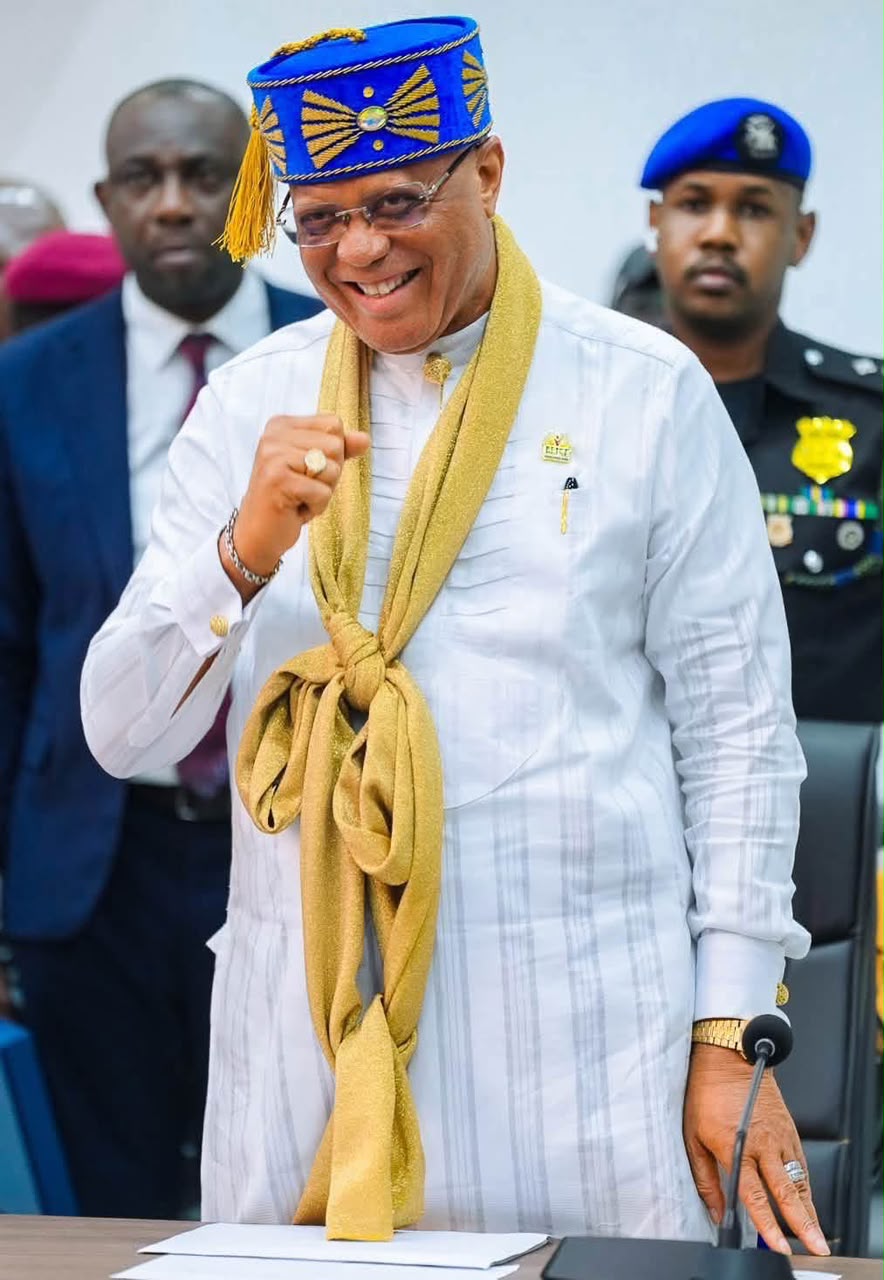
The special assistant on media to Akwa Ibom state governor Ekaette Okon Joseph has said in a statement issued to journalists in Calabar has said The true measure of governance is not the volume of political arguments surrounding an administration, but the difference its policies make in the lives of ordinary people. In Akwa Ibom State, Governor Umo Eno’s development story is increasingly visible in roads connecting communities, students receiving educational support, farmers and fishermen accessing grants, vulnerable families receiving homes and food, and retirees being paid long-awaited gratuities.
Explained “This is why the Eno administration deserves to be assessed beyond politics and through the tangible experiences of the people.”
The special Assistant on media highligjted that Since assuming office, Governor Eno has pursued a development agenda that combines infrastructure with economic empowerment, human capital development and social protection. The approach recognises that a state cannot build a strong economy without simultaneously improving the conditions in which its people live and work.
Added that “Consider infrastructure. The state government says the administration has embarked on about 1,305 kilometres of roads and 40 bridges. These are not merely statistics. For farmers, a good road can mean easier access to markets. For patients, it can mean faster access to healthcare. For traders and businesses, it can reduce the cost and difficulty of moving people and goods.”
On food securiry Ekaette Okon Joseoh further said Agriculture has received similar attention. The government has reported ₦2 billion in grants to farmers and ₦2.5 billion approved for 620,000 oil palm seedlings.
Support has also been extended to fishermen through various grants and interventions. These measures matter because sustainable development requires citizens to have the means to produce, earn and build livelihoods.
The same thinking is evident in support for women and small businesses. The government approved ₦20 million for cooperative societies in each of the state’s 369 wards, amounting to ₦7.38 billion. For a woman using such support to expand her business, the significance is not the size of the appropriation. It is the income, jobs and economic independence that may follow.
The administration’s free food distribution programme has provided food support to vulnerable citizens, recognising that families facing economic pressure cannot always wait for long-term interventions before receiving assistance. Such programmes demonstrate that governance must address both the future and the needs of today.
The Arise Compassionate Homes programme offers another powerful example. More than 460 homes have been completed and handed over to vulnerable families, according to the state government, with beneficiaries also receiving basic amenities and a ₦500,000 living grant.
A house, in this context, is more than a structure. It is security, dignity and a foundation from which a family can begin to rebuild.
Education remains another important pillar. The administration has continued bursary support for tertiary students and invested in schools, teacher recruitment and other educational interventions. It has also committed substantial resources to examination fees and student support.
For a family struggling to keep a child in school, a bursary or payment of examination fees can make the difference between continuation and interruption. The real value of such intervention may only become visible years later when the beneficiary becomes a graduate, professional or entrepreneur.
The administration’s handling of inherited gratuity obligations also illustrates the human consequences of public policy. The state government said it inherited ₦111 billion in outstanding gratuities dating back to 2012 and had paid more than ₦82 billion toward the backlog as of April 2026.
For a retired worker, such payment is not simply a budgetary figure. It can mean medical care, school fees, debt repayment or the restoration of financial dignity after years of waiting.
Healthcare and transportation have also formed part of the broader development picture. The 350-bed Ibom International Hospital represents a major investment in specialist healthcare, while Ibom Air’s expansion, including the planned Uyo-Accra service, strengthens connectivity. The government has also ordered 50 CNG buses, with 40 delivered as of August, to modernise public transportation and reduce pressure on commuters.
Meanwhile, programmes such as Ibom Community Watch have created opportunities for young people while supporting community security.
Taken together, these interventions tell a larger story.
The road connects the farmer to the market. The grant strengthens production. The bursary keeps a student in school. Food support cushions hardship. The Compassionate Home restores dignity. The gratuity payment honours an obligation. Healthcare protects lives. Transportation connects people and businesses.
This is why Governor Eno’s record should not be reduced to individual projects or political narratives. Its significance lies in the combined effect of interventions across different aspects of life.
Akwa Ibom needs development that can be seen, measured and experienced. It also needs political discourse capable of recognising progress where it exists while demanding even better performance where necessary.
Ultimately, the enduring question is simple: are the people better off?
When a farmer reaches the market more easily, a student stays in school, a woman expands her business, a fisherman receives support, a vulnerable family gets a home and food reaches households in need, the answer is found not in political rhetoric but in human experience.
.
Comments