
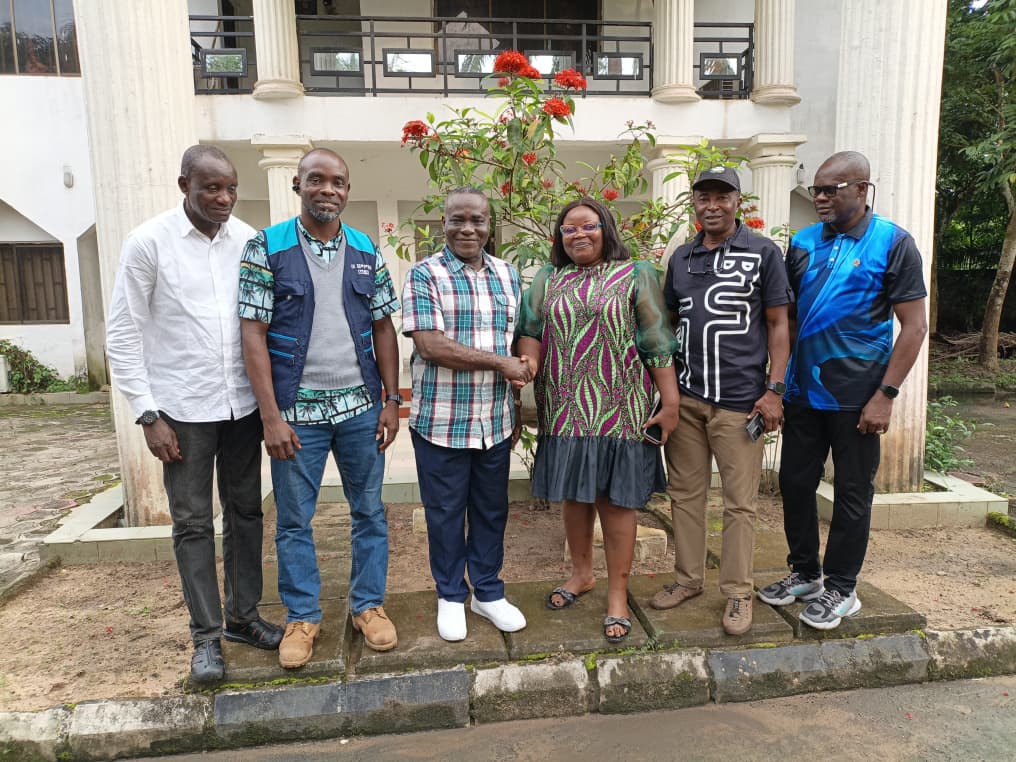
The Nigerian Ambassador to Germany, Senator Ita Enang, has expressed support for the Akwa Ibom State Rural Access and Agricultural Marketing Project (AKS-RAAMP), saying the programme has the potential to open up rural communities, stimulate agro-allied investments and improve livelihoods across the state.
Speaking at his country home in Ibiono Ibom Local Government Area, yesterday , while receiving a briefing from the AKS-RAAMP team on a reconnaissance survey of roads he had proposed for consideration under the project.
The Ambassador described the AKS-RAAMP team as performing well and said the project's success would be beneficial to the overall interest of Akwa Ibom State.
He emphasised that the intervention should go beyond road construction to create economic opportunities for rural residents, particularly farmers and young people.
According to him, improved rural access would enable agricultural communities to evacuate their produce to markets, encourage food production and create employment.
“RAAMP is intended to create access to communities where we have agricultural products; generate food production; enable farmers to evacuate their produce to markets and create employment for youths,” Enang said.
The Ambassador also drew attention to the financing structure of the project, stressing that the funds being invested in the programme constitute a loan that would eventually be repaid by the Akwa Ibom State Government.
He therefore called for judicious utilisation of the funds to ensure that the projects produce tangible and sustainable benefits.
“At the long run, Akwa Ibom will pay back the loan,” Enang said, adding that there must be identifiable projects and outcomes that would justify the financing.
He said the state should be able to point to tangible development benefits from the funds when repayment obligations arise.
The emphasis on returns, he noted, was important because the project was expected to deliver more than physical infrastructure.
The reconnaissance exercise followed a letter dated July 31, 2026, in which Enang submitted seven roads for consideration and possible construction under AKS-RAAMP.
Following the request, the State Project Coordinator of AKS-RAAMP, Pastor Gideon Akpan, promptly deployed a project team to identify the proposed roads and gather relevant information required for further assessment.
The field exercise included the collection of physical and socioeconomic data that could support subsequent planning and decision-making on the proposed interventions.
The reconnaissance survey is expected to provide the project with baseline information on the routes, surrounding communities and economic activities that could benefit from improved access.
Enang linked the proposed rural road interventions directly to agricultural development and rural economic growth.
He explained that improved roads would make it easier for farmers to transport agricultural produce from their communities to markets.
Better connectivity could also support agro-allied investments by making rural production areas more accessible to processors, traders and other businesses within the agricultural value chain.
The intervention, he said, could ultimately create employment opportunities for youths and contribute to improved livelihoods at the grassroots.
Enang also referenced his previous experience in government, particularly his involvement with development programmes supported by international financial institutions.
He said he had served in the Presidency as Adviser to the President on National Assembly Matters and later as Adviser on Niger Delta Affairs.
According to him, part of his responsibilities involved establishing linkages with projects and programmes supported by the World Bank, African Development Bank and other development partners.
“I am a patron of RAAMP in Nigeria,” he said, reaffirming his interest in the success of the rural access programme.
His support for the project comes as AKS-RAAMP continues to expand its focus on improving rural connectivity and strengthening access between agricultural communities and markets.
The project team deployed for the reconnaissance exercise comprised Akan Esinwang, Development Communications Officer; Uwem Jeremiah, Data Entry Specialist; Archibong Thomas, Assistant Monitoring and Evaluation Officer; Theresa Ekemini Donatus, Aide to the State Project Coordinator; and Utibe Yellow, Transport Officer.
The team was tasked with identifying the proposed roads, documenting relevant features and collating socioeconomic information for further action.
The information gathered during the exercise is expected to assist the project in evaluating the proposed routes and determining the appropriate next steps in line with its established procedures.
The proposed roads visited includes: Nsan – ITU Atan – Afaha Utuat – Mbabam Itidep – Efi North Itam- 3.4km; Ikot Udu – Ikot Inyang – Ididep to Federal College of Education -1.73km; Ikot Andem Highway – 1.3km; Ikot Akpan Nya to Itu Dam Fort- safe guards issues; Afahaise – Ono – Omu Ekene Road — Ibiono Ibom LGA and Afua – Idoro, Akpautong – Usuk Inyang — Ibiono Ibom LGA, Iba Oku – Usung Inwang – Uyo Village Road — Uyo LGA - 2.1 km
The Ambassador's remarks underscore the broader economic objective of rural access infrastructure.
For the proposed roads to deliver the intended benefits, improved connectivity would need to translate into measurable outcomes, including easier movement of farm produce, improved access to markets, increased economic activities and employment opportunities.
The success of the intervention would therefore ultimately be measured not only by the kilometres of roads constructed but by the extent to which the infrastructure improves the economic conditions of the communities it serves.
Enang's call for judicious use of the loan-funded resources also places emphasis on sustainability and accountability in the implementation of the project.
With seven additional roads now undergoing preliminary assessment following his request, stakeholders will be watching how the proposed interventions progress from reconnaissance and data collection to technical assessment, prioritisation and possible construction.
For the Ambassador, the objective is clear: the investment in rural access must produce tangible development outcomes capable of improving the lives of farmers, creating opportunities for young people and strengthening Akwa Ibom's rural economy.
Comments