
Nigeria stands today at one of the most decisive moments in her history. Ours is a nation richly blessed by God with human and natural resources, yet deeply wounded by decades of poor leadership, institutional decay, intellectual laziness, corruption, tribal suspicion, and moral confusion. The tragedy of Nigeria is not merely economic; it is fundamentally philosophical, moral, and spiritual. Therefore, the healing Nigeria requires cannot come only from politicians seeking power, but from leaders who understand the soul of society, the dignity of the human person, and the sacred responsibility of governance.
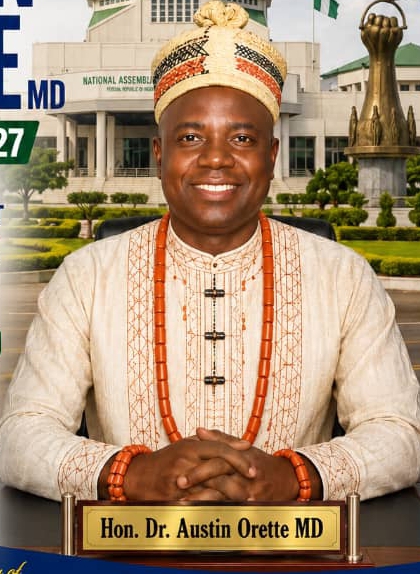
It is for this reason that I, as a Catholic Priest and Canon Lawyer, openly and intellectually support Dr. Austin Orette MD in his aspiration for the Senate representing Delta South Senatorial District in 2027.
Some may ask: “Why should a Catholic priest concern himself with politics?” The answer is simple. Because politics concerns human beings, and the Church exists for the salvation, dignity, and total well-being of the human person.
The Catholic Church is not merely a religious institution; she is the Universal Church established by Christ Himself. Her mission extends into every sphere where human dignity, justice, morality, truth, and peace are threatened. The Church has historically shaped civilizations, legal systems, educational institutions, moral philosophy, and governance structures across the world. Long before many modern states emerged, the Church was already articulating principles of justice, human rights, social order, and responsible authority.
Canon Law, therefore, is not an ordinary legal system. Canon Law is the body of laws and regulations that governs the Catholic Church — the Universal Church. It is one of the oldest continuously functioning legal systems in human history. Through Canon Law, the Church regulates discipline, justice, rights, obligations, administration, and moral order within a global spiritual civilization that transcends race, tribe, nationality, and political boundaries.
In this sense, a Canon Lawyer is not restricted merely to ecclesiastical rituals. He is trained in universal principles concerning justice, morality, governance, rights, obligations, institutional accountability, and the ordering of society toward the common good. Since religion in one form or another touches virtually every human being on earth, the religious lawyer inevitably becomes a universal lawyer capable of speaking meaningfully to nearly every sphere of human existence.
The Code of Canon Law itself recognizes the dignity and rights of citizens within society. Canon 747 affirms the Church’s right and duty to proclaim moral principles even concerning the social order whenever the fundamental rights of persons or the salvation of souls require it. Likewise, Canon 225 reminds the faithful that they have an obligation to permeate the temporal order with the spirit of the Gospel. Therefore, when a priest speaks on justice, governance, corruption, truth, or national healing, he is not abandoning his mission; he is fulfilling it.
The Holy Scriptures equally compel moral engagement with society. Proverbs 29:2 declares:
“When the righteous are in authority, the people rejoice: but when the wicked rule, the people mourn.”
The prophet Isaiah cries out:
“Learn to do good; seek justice, correct oppression.” — Isaiah 1:17.
Our Lord Jesus Christ Himself confronted hypocrisy, injustice, exploitation, and abuse of power. Christianity has never been a religion of cowardly silence before societal decay.
Saint Thomas Aquinas, one of the greatest philosophers and theologians in history, teaches that law must always serve the common good. According to him, unjust laws are acts of violence rather than authentic laws. Governance without moral purpose degenerates into organized exploitation.
Saint Augustine warned centuries ago:
“Without justice, what are kingdoms but great robberies?”
These truths remain painfully relevant in modern Nigeria.
The Stoic philosophers also understood the moral responsibility of leadership. Marcus Aurelius taught that the duty of leadership is service guided by reason and virtue. Seneca warned that societies collapse when greed and excess dominate public life. Epictetus insisted that true power belongs to those who master wisdom, discipline, and integrity rather than those enslaved by selfish passions.
Plato argued in The Republic that the state suffers whenever leadership falls into the hands of men who lack philosophical discipline and moral formation. Aristotle taught that politics exists not merely for survival, but to enable citizens to live good and virtuous lives.
Unfortunately, Nigeria has too often suffered under a political culture that rewards emotional manipulation instead of intellectual depth, tribal sentiment instead of competence, propaganda instead of truth, and selfish ambition instead of sacrificial leadership.
This is precisely why Dr. Austin Orette MD stands out.
Dr. Austin Orette represents more than a political aspiration; he represents a philosophical shift. As a medical doctor, he understands healing. As an intellectual voice, he understands critical reasoning. As a public figure, he consistently demonstrates concern for institutional reform, national consciousness, and the restoration of dignity within governance.
Nigeria today does not merely need politicians. Nigeria needs healers. We need leaders capable of diagnosing the moral, intellectual, and institutional diseases crippling the nation. We need leaders who understand that governance is not entertainment but responsibility.
In my interactions and observations of Dr. Austin Orette MD, I have encountered a man deeply committed to critical thinking, civic enlightenment, justice, accountability, and national transformation. His political philosophy encourages Nigerians to think independently, question deception, resist exploitation, and embrace enlightened participation in public affairs.
This is extremely important because one of the greatest tragedies in Nigeria is the collapse of critical thinking among the populace. Too many citizens have been conditioned to worship personalities instead of principles, defend corruption because of ethnicity, and celebrate mediocrity while attacking excellence.
A society cannot progress when emotionalism replaces rationality.
Dr. Austin Orette’s approach speaks directly to this crisis. He inspires intellectual engagement rather than blind followership. He encourages thoughtful dialogue rather than toxic division. He advocates healing rather than hatred.
As a Senator, I believe he possesses the capacity to contribute meaningfully toward restoring legislative seriousness, evidence-based policymaking, institutional accountability, and responsible national discourse.
The Senate must not become a theatre of noise and personal enrichment. It must become a sanctuary of ideas, justice, patriotism, and national reconstruction.
The philosopher Edmund Burke once stated:
“The only thing necessary for the triumph of evil is for good men to do nothing.”
Silence in the face of national decline is not neutrality; it is complicity.
Therefore, my support for Dr. Austin Orette MD is not rooted in sentiment or personal gain. It is rooted in conviction — philosophical conviction, moral conviction, intellectual conviction, and patriotic conviction.
Nigeria needs leaders who can think deeply, act justly, speak courageously, and govern compassionately.
The future of Delta South and indeed Nigeria cannot be entrusted continually to mediocrity, impulsiveness, and recycled political emptiness.
We must begin to support men and women capable of healing institutions, rebuilding trust, defending truth, empowering citizens, and restoring hope.
As a Catholic Priest and Canon Lawyer, I believe that supporting credible leadership is not merely political participation; it is part of moral responsibility toward society and future generations.
May God bless Delta South.
May God heal Nigeria.
And may wisdom once again rise within our national life.
*#DrAustinOrette2027*
Comments